Nahum is a bit hard to read because it is harsh.
The justice of God is fair but nonetheless hard to hear.
Onward to Nahum 3:1-19.
In this chapter, we get a blend of the description of the judgement that will fall on Nineveh, the capital city of the Assyrian Empire, God speaking directly and a final concluding announcement of judgement.
The judgement described, vv. 1-4.
The bold texts below are from the NET. Read it aloud. The translation seems to be trying to capture the cadences of a preached message of doom. It begins with a description of why judgement will fall on them.
Woe to the city guilty of bloodshed!
She is full of lies;
she is filled with plunder;
she has hoarded her spoil!
It is then followed by this series of images you can see and hear in drumbeat like fashion:
The chariot drivers will crack their whips;
the chariot wheels will shake the ground;
the chariot horses will gallop;
the war chariots will bolt forward!
The charioteers will charge ahead;
their swords will flash
and their spears will glimmer!
There will be many people slain;
there will be piles of the dead,
and countless casualties –
so many that people will stumble over the corpses.
Nahum then returns once again as to why this nation deserves judgement.
Because you have acted like a wanton prostitute –
a seductive mistress who practices sorcery,
who enslaves nations by her harlotry,
and entices peoples by her sorcery –
Periodically, in the text of Nahum, God speaks directly. We have seen this before in 1:12-14 and 2:13. We see this again in 3:5-7.
"I am against you," declares the Lord who commands armies.
"I will strip off your clothes!
I will show your nakedness to the nations
and your shame to the kingdoms;
I will pelt you with filth;
I will treat you with contempt;
I will make you a public spectacle.
Everyone who sees you will turn away from you in disgust;
they will say, 'Nineveh has been devastated!
Who will lament for her?'
There will be no one to comfort you!"
Again the drumbeat cadence of repetitions of doom. We would prefer to think about how God loves the world and sent His Son Jesus to be the Savior and we definitely should immerse ourselves in the truth of God's grace. But if God is truly a God who will receive the sinner who turns from their sins, what is God suppose to do about the sinner who doesn't turn from their sin? What is God to do about an nation that has sinned and won't change its ways? Would God be worthy of worship if God forgives the repentant sinner but doesn't judge the one who refuses to repent?
In vv. 8-11, we get an anchor into another historic reality of that era of ancient history in the citation of the judgement of Thebes which fell in 663 BCE. Assyria would fall in 612. Turns out in a bit of justice, it was the Assyrians who sacked Thebes though this article cites the date as 661. Nonetheless, what irony that those who destroyed Thebes would suffer the same fate!
You are no more secure than Thebes –
she was located on the banks of the Nile;
the waters surrounded her,
her rampart was the sea,
the water was her wall.
Cush and Egypt had limitless strength;
Put and the Libyans were among her allies.
Yet she went into captivity as an exile;
even her infants were smashed to pieces at the head of every street.
They cast lots for her nobility;
all her dignitaries were bound with chains.
You too will act like drunkards;
you will go into hiding;
you too will seek refuge from the enemy.
Nahum returns once again to a doleful recitation of the doom that will fall upon Nineveh in vv. 12-17.
All your fortifications will be like fig trees with first-ripe fruit:
If they are shaken, their figs will fall into the mouth of the eater!
Your warriors will be like women in your midst;
the gates of your land will be wide open to your enemies;
fire will consume the bars of your gates.
Draw yourselves water for a siege!
Strengthen your fortifications!
Trample the mud and tread the clay!
Make mud bricks to strengthen your walls!
There the fire will consume you;
the sword will cut you down;
it will devour you like the young locust would.
Multiply yourself like the young locust;
multiply yourself like the flying locust!
Increase your merchants more than the stars of heaven!
They are like the young locust which sheds its skin and flies away.
Your courtiers are like locusts,
your officials are like a swarm of locusts!
They encamp in the walls on a cold day,
yet when the sun rises, they fly away;
and no one knows where they are.
The methods of poetry can be used to potent effect with its evocation of images and sound and smells thorough word choices. Even the very pattern of repetition of ideas slightly changed with each line contributes to the mood. And here the doom and despair just hammers home hard.
Nahum ends with one final parting shot in vv. 18-19 which forms a counter-point to Nahum 1:15-2:2 which described the fall of Assyria and Nineveh from the perspective of celebration for the oppressed Israelites. For the oppressed, proclaim on the mountains the good news of Assyria's fall. For the Assyrians, are see themselves scattered like sheep on the mountain. For the Israelites, they can celebrate and experience restoration. For Nineveh, it is the end of line, their demise and destruction if a fatal injury and incurable wound.
Your shepherds are sleeping, O king of Assyria!
Your officers are slumbering!
Your people are scattered like sheep on the mountains
and there is no one to regather them!
Your destruction is like an incurable wound;
your demise is like a fatal injury!
All who hear what has happened to you will clap their hands for joy,
for no one ever escaped your endless cruelty!
Lord, your rulership in this world is breaking in for at the Cross of Christ there is good news. Your victory has begun but has not been completed yet. Help me as an individual and help us as a people who follow you to fight the wickedness within ourselves and strive to combat the wickedness in our society that destroys lives. God speed the days of restoration and heighten the visibility of your goodness in this world. Amen.
Wednesday, August 31, 2011


Friday, August 12, 2011
Nahum 2:11-13
Let's recap up to this point.
In Nahum 1:1 we are introduced to Nahum. Beyond what is in this verse, we know nothing else about him.
Nahum 1:2-8 stressed the character of God
Nahum 1:9-11 began the announcement of the judgment upon Nineveh.
God is referred to in the third person in this section.
Nahum 1:12-14 God spoke of judgment in first person.
Nahum 1:15-2:10 the judgment against Nineveh is described in very vivid terms.
And now let's enter a brief reflection on Nahum 2:11-13 where the imagery is of a lion (Nineveh) now decimated. Additionally, God spoke again in first person in verse 13 using the image of a lion for Nineveh.
Verses 11-12
Where now is the den of the lions,
the feeding place of the young lions,
where the lion, lioness, and lion cub once prowled
and no one disturbed them?
The lion tore apart as much prey as his cubs needed
and strangled prey to provide food for his lionesses;
he filled his lairs with prey
and his dens with torn flesh.
The lion is probably the most fierce animal in the ancient world. Elephants might be bigger but the sight of a lion pouncing on its prey and tearing it apart must have been one of the most scary and awe-inspiring sights. In the NETBible study note #77 on this passage, it said the Assyrians saw themselves as lions. Thus, this part here turns their national image of themselves on its head.
This section concluded with God speaking out against them.
"I am against you!" declares the Lord who commands armies:
I will burn your chariots with fire;
the sword will devour your young lions;
you will no longer prey upon the land;
the voices of your messengers will no longer be heard."
NETBible
We usually prefer thinking in more positive terms: if God is for us, who can be against us?
Here it is turned upside down, if God is against us, what chance do we have?
And indeed, Assyria was utterly destroyed.
How do we stand in the face of God in response to a passage like this?
I recently heard a lecture on the life of John Calvin. The speaker, Fred Sanders, admitted he was trained at a seminary that wasn't supportive of all of Calvin's theological ideas. But he believed he learned very much about how to approach the Scriptures in an honest and thorough way by reading John Calvin's magnum opus, Institutes of the Christian Religion. Sanders admired Calvin's attitude of "doing theology before the face of God." In the end, Sanders shared, when we "do theology" we are trying to express our understanding of God and in order to do it seriously, we have to be willing to say our theology back to God.
Because of this endorsement from a non-Calvinist, I have decided I'll try to read this famous work. I suspect it will be in fits and starts as it is a very large work and not always the easiest reading!
I came across this in Chapter II, part II:
"... he embraces him not less as the avenger of wickedness than as the rewarder of the righteous; because he perceives that it equally appertains to his glory to store up punishment for the one, and eternal life for the other."
Yes, God is the God of the simple but profound truth, "Jesus loves me this I know for the Bible tells me so. Little ones to Him belong, they are weak but He is strong."
As I read Nahum, do I also embrace this God who is the "avenger of wickedness?"
Lord, as one who wants to understand your ways and live for you, it isn't easy to think about the hard things of God. But, indeed, if I am to praise your goodness and kind mercies, I need to praise you for your justice that will fall upon those who are wicked. In this passage in Nahum, I see that no one escapes and judgment fell upon an evil nation. Lord, have mercy and help bring about repentance and reconciliation in the world today in all its hard places. Thy Kingdom come and with may the fullness of justice and restoration and reversal come too. Amen.
In Nahum 1:1 we are introduced to Nahum. Beyond what is in this verse, we know nothing else about him.
Nahum 1:2-8 stressed the character of God
Nahum 1:9-11 began the announcement of the judgment upon Nineveh.
God is referred to in the third person in this section.
Nahum 1:12-14 God spoke of judgment in first person.
Nahum 1:15-2:10 the judgment against Nineveh is described in very vivid terms.
And now let's enter a brief reflection on Nahum 2:11-13 where the imagery is of a lion (Nineveh) now decimated. Additionally, God spoke again in first person in verse 13 using the image of a lion for Nineveh.
Verses 11-12
Where now is the den of the lions,
the feeding place of the young lions,
where the lion, lioness, and lion cub once prowled
and no one disturbed them?
The lion tore apart as much prey as his cubs needed
and strangled prey to provide food for his lionesses;
he filled his lairs with prey
and his dens with torn flesh.
The lion is probably the most fierce animal in the ancient world. Elephants might be bigger but the sight of a lion pouncing on its prey and tearing it apart must have been one of the most scary and awe-inspiring sights. In the NETBible study note #77 on this passage, it said the Assyrians saw themselves as lions. Thus, this part here turns their national image of themselves on its head.
This section concluded with God speaking out against them.
"I am against you!" declares the Lord who commands armies:
I will burn your chariots with fire;
the sword will devour your young lions;
you will no longer prey upon the land;
the voices of your messengers will no longer be heard."
NETBible
We usually prefer thinking in more positive terms: if God is for us, who can be against us?
Here it is turned upside down, if God is against us, what chance do we have?
And indeed, Assyria was utterly destroyed.
How do we stand in the face of God in response to a passage like this?
I recently heard a lecture on the life of John Calvin. The speaker, Fred Sanders, admitted he was trained at a seminary that wasn't supportive of all of Calvin's theological ideas. But he believed he learned very much about how to approach the Scriptures in an honest and thorough way by reading John Calvin's magnum opus, Institutes of the Christian Religion. Sanders admired Calvin's attitude of "doing theology before the face of God." In the end, Sanders shared, when we "do theology" we are trying to express our understanding of God and in order to do it seriously, we have to be willing to say our theology back to God.
Because of this endorsement from a non-Calvinist, I have decided I'll try to read this famous work. I suspect it will be in fits and starts as it is a very large work and not always the easiest reading!
I came across this in Chapter II, part II:
"... he embraces him not less as the avenger of wickedness than as the rewarder of the righteous; because he perceives that it equally appertains to his glory to store up punishment for the one, and eternal life for the other."
Yes, God is the God of the simple but profound truth, "Jesus loves me this I know for the Bible tells me so. Little ones to Him belong, they are weak but He is strong."
As I read Nahum, do I also embrace this God who is the "avenger of wickedness?"
Lord, as one who wants to understand your ways and live for you, it isn't easy to think about the hard things of God. But, indeed, if I am to praise your goodness and kind mercies, I need to praise you for your justice that will fall upon those who are wicked. In this passage in Nahum, I see that no one escapes and judgment fell upon an evil nation. Lord, have mercy and help bring about repentance and reconciliation in the world today in all its hard places. Thy Kingdom come and with may the fullness of justice and restoration and reversal come too. Amen.
Monday, July 25, 2011
Nahum 2:3-10
Poetry fires up the imagination. As you read poetry, it engages the senses: you can hear the sounds and see the colors and feel the anguish. And, indeed, the destruction meted out upon Nineveh was described in very vivid manner in the portions below found in Nahum 2:3-10.
The shields of his warriors are dyed red;
the mighty soldiers are dressed in scarlet garments.
The metal fittings of the chariots shine
like fire on the day of battle;
the soldiers brandish their spears.
The chariots race madly through the streets,
they rush back and forth in the broad plazas;
they look like lightning bolts,
they dash here and there like flashes of lightning.
The commander orders his officers;
they stumble as they advance;
they rush to the city wall
and they set up the covered siege tower.
The sluice gates are opened;
the royal palace is deluged and dissolves.
Some parts of Scripture are unique to the Scripture. In some cases, what was described in the Bible was also described in other literature of the times. And in some cases, archeological evidence support the descriptions of ancient literature including the Bible.
It seems that this particular event, the fall of Nineveh and Assyria would fall into that the category of being present in the Bible, other literature and archeology if Wikipedia can be taken as accurate on this point in the "historical context" paragraph. More can be found in their entry on Nineveh.
Nahum continued the prophecy about the calamity that would befall Nineveh ...
Nineveh is taken into exile and is led away;
her slave girls moan like doves while they beat their breasts.
Nineveh was like a pool of water throughout her days,
but now her people are running away;
she cries out: "Stop! Stop!" -
but no one turns back.
Her conquerors cry out:
"Plunder the silver! Plunder the gold!"
There is no end to the treasure;
riches of every kind of precious thing.
Destruction, devastation, and desolation!
Their hearts faint,
their knees tremble,
each stomach churns, each face turns pale!
NET
Chilling word pictures!
In reading the Wikipedia entries on Assyria and Nineveh, the archeological digs suggest that "destruction, devastation and desolation" would be an accurate description of what happened there.
An analogy might be made to 20th century history where by the end of World War II many parts of Germany and Japan were in ruins.
But what about the "big" theological point: the rise and fall of nations occur at the discretion of God?
I don't think one can "prove" this idea. I think that would be a faith claim based on revelation. However, one might make an inference from the idea of "justice" that there is a God. Using World War II as an example, most people view it as a "just war" because of the atrocities committed by the Axis nations. Where does this sense of justice come from?
Of course, some might argue, in the end, it was just a matter of raw power and that the Allies had more raw power and they prevailed because of that. Perhaps so.
In the final analysis, in my mind, I would be very sad if there was no God with the resulting situation that injustice in too many cases would prevail and be the last word. Of course, this does not mean, those who believe in God sit idle waiting for God to bring justice. Instead, we are to do justice the best we can with humility mixed with mercy. But sometimes, it is beyond us and we have to beseech God.
Lord, as I reflect today, there is injustice in the world. Lots of it. Just a few days ago, nearly a 100 people were killed by one evil man in Norway. We cry out for justice upon those who do evil. We cry out for mercy for us who have failed to stop injustice big and small when we had the opportunity to do so. Amen.
The shields of his warriors are dyed red;
the mighty soldiers are dressed in scarlet garments.
The metal fittings of the chariots shine
like fire on the day of battle;
the soldiers brandish their spears.
The chariots race madly through the streets,
they rush back and forth in the broad plazas;
they look like lightning bolts,
they dash here and there like flashes of lightning.
The commander orders his officers;
they stumble as they advance;
they rush to the city wall
and they set up the covered siege tower.
The sluice gates are opened;
the royal palace is deluged and dissolves.
Some parts of Scripture are unique to the Scripture. In some cases, what was described in the Bible was also described in other literature of the times. And in some cases, archeological evidence support the descriptions of ancient literature including the Bible.
It seems that this particular event, the fall of Nineveh and Assyria would fall into that the category of being present in the Bible, other literature and archeology if Wikipedia can be taken as accurate on this point in the "historical context" paragraph. More can be found in their entry on Nineveh.
Nahum continued the prophecy about the calamity that would befall Nineveh ...
Nineveh is taken into exile and is led away;
her slave girls moan like doves while they beat their breasts.
Nineveh was like a pool of water throughout her days,
but now her people are running away;
she cries out: "Stop! Stop!" -
but no one turns back.
Her conquerors cry out:
"Plunder the silver! Plunder the gold!"
There is no end to the treasure;
riches of every kind of precious thing.
Destruction, devastation, and desolation!
Their hearts faint,
their knees tremble,
each stomach churns, each face turns pale!
NET
Chilling word pictures!
In reading the Wikipedia entries on Assyria and Nineveh, the archeological digs suggest that "destruction, devastation and desolation" would be an accurate description of what happened there.
An analogy might be made to 20th century history where by the end of World War II many parts of Germany and Japan were in ruins.
But what about the "big" theological point: the rise and fall of nations occur at the discretion of God?
I don't think one can "prove" this idea. I think that would be a faith claim based on revelation. However, one might make an inference from the idea of "justice" that there is a God. Using World War II as an example, most people view it as a "just war" because of the atrocities committed by the Axis nations. Where does this sense of justice come from?
Of course, some might argue, in the end, it was just a matter of raw power and that the Allies had more raw power and they prevailed because of that. Perhaps so.
In the final analysis, in my mind, I would be very sad if there was no God with the resulting situation that injustice in too many cases would prevail and be the last word. Of course, this does not mean, those who believe in God sit idle waiting for God to bring justice. Instead, we are to do justice the best we can with humility mixed with mercy. But sometimes, it is beyond us and we have to beseech God.
Lord, as I reflect today, there is injustice in the world. Lots of it. Just a few days ago, nearly a 100 people were killed by one evil man in Norway. We cry out for justice upon those who do evil. We cry out for mercy for us who have failed to stop injustice big and small when we had the opportunity to do so. Amen.
Tuesday, May 03, 2011
Nahum 2:1-2
Nahum 2:1-2
The watchmen of Nineveh shout:
An enemy who will scatter you is marching out to attack you!
Guard the rampart!
Watch the road!
Prepare yourselves for battle!
Muster your mighty strength!
The pronouncement against Nineveh gets more specific in chapter two after chapter one's more sweeping statements pertaining to God's justice and mercy. Now, the hammer of justice is about to fall and Nineveh can see it coming!
The first remark in the NET seems a bit odd to me, The watchmen of Nineveh shout, considering the 5 lines that follow.
According to the NET notes for verse 1, The introductory phrase “The watchmen of Nineveh shout” is not in the Hebrew text, but has been supplied from the context for clarity.
Perhaps, if it was rendered this way, it would make more sense?
An enemy who will scatter you is marching out to attack you!
Thus, your watchman should shout:
Guard the rampart!
Watch the road!
Prepare yourselves for battle!
Muster your mighty strength!
For the Lord will restore the majesty of Jacob, as well as the majesty of Israel, though their enemies have plundered them and have destroyed their fields.
NET
And so indeed, Israel/Jacob would be restored and those who had plundered the people of God will get their comeuppance which will be further described in the next parts of chapter 2.
I took a look at Harper's Bible Commentary for some analysis of Nahum. They too point out that Nahum portrays a fearsome God. They also point out that Nahum should be read in light of Jonah that is also about God and Nineveh.
We have all heard the story of Jonah being swallowed by a fish. What you may not know is that Jonah eventually went to Nineveh to tell them to repent or God is going to judge them. And, indeed, the people of Nineveh did repent and God spared them.
Thus, if one reads both Jonah and Nahum in sequence, one would have a clear picture that God doesn't just blast people without giving them a chance to change their ways. Indeed, it would seem Nineveh did turn back once before but by the time of Nahum, they had slipped back into wickedness and God's justice came back to the forefront.
Lord, you are both merciful and just. Those who have turned their back on your mercy have decided they want to face your justice. I pray thy kingdom come. I trust in your timing. As you delay, I ask that your call of repentance, your patient mercy and your gracious desire for reconciliation will be responded to. Amen.
The watchmen of Nineveh shout:
An enemy who will scatter you is marching out to attack you!
Guard the rampart!
Watch the road!
Prepare yourselves for battle!
Muster your mighty strength!
The pronouncement against Nineveh gets more specific in chapter two after chapter one's more sweeping statements pertaining to God's justice and mercy. Now, the hammer of justice is about to fall and Nineveh can see it coming!
The first remark in the NET seems a bit odd to me, The watchmen of Nineveh shout, considering the 5 lines that follow.
According to the NET notes for verse 1, The introductory phrase “The watchmen of Nineveh shout” is not in the Hebrew text, but has been supplied from the context for clarity.
Perhaps, if it was rendered this way, it would make more sense?
An enemy who will scatter you is marching out to attack you!
Thus, your watchman should shout:
Guard the rampart!
Watch the road!
Prepare yourselves for battle!
Muster your mighty strength!
For the Lord will restore the majesty of Jacob, as well as the majesty of Israel, though their enemies have plundered them and have destroyed their fields.
NET
And so indeed, Israel/Jacob would be restored and those who had plundered the people of God will get their comeuppance which will be further described in the next parts of chapter 2.
I took a look at Harper's Bible Commentary for some analysis of Nahum. They too point out that Nahum portrays a fearsome God. They also point out that Nahum should be read in light of Jonah that is also about God and Nineveh.
We have all heard the story of Jonah being swallowed by a fish. What you may not know is that Jonah eventually went to Nineveh to tell them to repent or God is going to judge them. And, indeed, the people of Nineveh did repent and God spared them.
Thus, if one reads both Jonah and Nahum in sequence, one would have a clear picture that God doesn't just blast people without giving them a chance to change their ways. Indeed, it would seem Nineveh did turn back once before but by the time of Nahum, they had slipped back into wickedness and God's justice came back to the forefront.
Lord, you are both merciful and just. Those who have turned their back on your mercy have decided they want to face your justice. I pray thy kingdom come. I trust in your timing. As you delay, I ask that your call of repentance, your patient mercy and your gracious desire for reconciliation will be responded to. Amen.
Sunday, October 31, 2010
Nahum 1:12-15
Nahum 1:12-15 continued the proclamation against Nineveh but now God is described in the first person.
This is what the LORD says:
"Even though they are powerful -
and what is more, even though their army is numerous -
nevertheless, they will be destroyed and trickle away!
The rising and falling of great powers seems to be an inevitable part of the history of nations. One way of looking at this would be to attribute the instrumental cause of the Fall of Assyria to the rival forces of the era as described in ancient documents. However, in Nahum, God is viewed as the principle cause ...
Although I afflicted you,
I will afflict you no more.
And now, I will break Assyria's yoke bar from your neck;
I will tear apart the shackles that are on you."
The LORD has issued a decree against you:
"Your dynasty will come to an end.
I will destroy the idols and images in the temples of your gods.
I will desecrate your grave - because you are accursed!"
Look! A herald is running on the mountains!
A messenger is proclaiming deliverance:
"Celebrate your sacred festivals, O Judah!
Fulfill your sacred vows to praise God!
For never again will the wicked Assyrians invade you,
they have been completely destroyed."
(NET)
Would we dare do this today?
Would we dare attribute to God the principle cause of judgment, today?
Certainly, some people took a "prophetic" cloak and said that the 9/11 attack on America was God's judgment on the US for fill-in-the-blank reason(s). Thus, the instrumental cause would have been the 19 terrorists and the entities that supported them. Or some would proclaim the economic collapse of the last few years was God's judgment upon America's sin of greed. Again, an instrumental cause of the crisis could be identified but the principle cause would be God's judgment.
This kind of attribution to God's activity was proposed by Abraham Lincoln in regards to the Civil War in his Second Inaugural Address. Excerpt:
But what about us? Can we do the same?
I suspect not. I think we can only go as far as Abraham Lincoln did. Lincoln took a prophetic tone but mixed it with a strong dose of humility.
I would not assign God as behind any political party. I can't imagine transferring the words of Nahum 1:12-15 from the Assyrians to fill-in-your-political opponent. In my mind, that would be wrong.
But what if one considers some of the horrible things that happen in some parts of the world? In places where children are forced into the sex trade, what does one say? In places where women can be killed because they dishonored the family, what does one say? In places where opponents of a dictatorship are disappeared, what does one say?
In those situations I want to be able to hear God say,
And now, I will break the oppressor's yoke bar from your neck.
I will tear apart the shackles that are on you.
Your authority will come to an end.
I will destroy the symbols of your power.
I will desecrate the graves of those you honor because you are accursed!
I suppose I could pray like that in my prayer closet?
But what if I'm in the position of authority to sway or command others? Can one take that up that kind of language?
We can't abdicate the responsibility of using discernment in choosing a course of action to deal with injustice in the world!
But can we claim this kind of prophet language?
Would the kind of language Lincoln took in the closing from the Second Inaugural be appropriate?
Lord, have mercy. I want to see the oppressor's yoke bar broken where ever oppression is found. We are made in the image of God and I pray where sinful humanity has placed chains upon our fellow man that you would tear apart those chains. Crush those earthly powers that mock the value of human life. With humility and grieving and love but with conviction help me to pray that thy will be done on earth as it is in heaven. And grant to me the strength and wisdom to do justice, love mercy and walk humbly with God. Amen.
This is what the LORD says:
"Even though they are powerful -
and what is more, even though their army is numerous -
nevertheless, they will be destroyed and trickle away!
The rising and falling of great powers seems to be an inevitable part of the history of nations. One way of looking at this would be to attribute the instrumental cause of the Fall of Assyria to the rival forces of the era as described in ancient documents. However, in Nahum, God is viewed as the principle cause ...
Although I afflicted you,
I will afflict you no more.
And now, I will break Assyria's yoke bar from your neck;
I will tear apart the shackles that are on you."
The LORD has issued a decree against you:
"Your dynasty will come to an end.
I will destroy the idols and images in the temples of your gods.
I will desecrate your grave - because you are accursed!"
Look! A herald is running on the mountains!
A messenger is proclaiming deliverance:
"Celebrate your sacred festivals, O Judah!
Fulfill your sacred vows to praise God!
For never again will the wicked Assyrians invade you,
they have been completely destroyed."
(NET)
Would we dare do this today?
Would we dare attribute to God the principle cause of judgment, today?
Certainly, some people took a "prophetic" cloak and said that the 9/11 attack on America was God's judgment on the US for fill-in-the-blank reason(s). Thus, the instrumental cause would have been the 19 terrorists and the entities that supported them. Or some would proclaim the economic collapse of the last few years was God's judgment upon America's sin of greed. Again, an instrumental cause of the crisis could be identified but the principle cause would be God's judgment.
This kind of attribution to God's activity was proposed by Abraham Lincoln in regards to the Civil War in his Second Inaugural Address. Excerpt:
If we shall suppose that American Slavery is one of those offenses which, in the providence of God, must needs come, but which, having continued through His appointed time, He now wills to remove, and that He gives to both North and South, this terrible war, as the woe due to those by whom the offense came, shall we discern therein any departure from those divine attributes which the believers in a Living God always ascribe to Him? Fondly do we hope -- fervently do we pray -- that this mighty scourge of war may speedily pass away. Yet, if God wills that it continue, until all the wealth piled by the bond-man's two hundred and fifty years of unrequited toil shall be sunk, and until every drop of blood drawn with the lash, shall be paid by another drawn with the sword, as was said three thousand years ago, so still it must be said "the judgments of the Lord, are true and righteous altogether."Nahum had the anointing of God as a prophet to speak for God. Jews and Christians accept that as an article of faith.
But what about us? Can we do the same?
I suspect not. I think we can only go as far as Abraham Lincoln did. Lincoln took a prophetic tone but mixed it with a strong dose of humility.
I would not assign God as behind any political party. I can't imagine transferring the words of Nahum 1:12-15 from the Assyrians to fill-in-your-political opponent. In my mind, that would be wrong.
But what if one considers some of the horrible things that happen in some parts of the world? In places where children are forced into the sex trade, what does one say? In places where women can be killed because they dishonored the family, what does one say? In places where opponents of a dictatorship are disappeared, what does one say?
In those situations I want to be able to hear God say,
And now, I will break the oppressor's yoke bar from your neck.
I will tear apart the shackles that are on you.
Your authority will come to an end.
I will destroy the symbols of your power.
I will desecrate the graves of those you honor because you are accursed!
I suppose I could pray like that in my prayer closet?
But what if I'm in the position of authority to sway or command others? Can one take that up that kind of language?
We can't abdicate the responsibility of using discernment in choosing a course of action to deal with injustice in the world!
But can we claim this kind of prophet language?
Would the kind of language Lincoln took in the closing from the Second Inaugural be appropriate?
With malice toward none; with charity for all; with firmness in the right, as God gives us to see the right, let us strive on to finish the work we are in; to bind up the nation's wounds; to care for him who shall have borne the battle, and for his widow, and his orphan -- to do all which may achieve and cherish a just, and a lasting peace, among ourselves, and with all nations.I don't have any answers. I just have questions. But I have no question about the reality that injustice still runs rampant in this world. I want God to fix it. And I want the wisdom to know how to do justice in the realms where I can have an impact and trust God in the realms where I have no impact. Is that arrogant? Is that wrong?
Lord, have mercy. I want to see the oppressor's yoke bar broken where ever oppression is found. We are made in the image of God and I pray where sinful humanity has placed chains upon our fellow man that you would tear apart those chains. Crush those earthly powers that mock the value of human life. With humility and grieving and love but with conviction help me to pray that thy will be done on earth as it is in heaven. And grant to me the strength and wisdom to do justice, love mercy and walk humbly with God. Amen.
Tuesday, September 28, 2010
Nahum 1:2-11
Nahum 1:2-11 continued our introduction to the book of Nahum. It sets the stage and begins the pronouncements of judgment upon Nineveh (Assyrians).
In some cases, Nahum spoke of God in the third person and on other occasions he spoke for God in the first person.
In this section, he used third person. There was much text describing God as fully capable and willing to let the hammer of justice fall! I've broken the text up into 5 blocks. If you only read blocks A, C and E, you may think that God is just mean! But blocks B and D put the fierce parts into context.
Take a look ...
(A)
The Lord is a zealous and avenging God;
the Lord is avenging and very angry.
The Lord takes vengeance against his foes;
he sustains his rage against his enemies.
(B)
The Lord is slow to anger but great in power;
the Lord will certainly not allow the wicked to go unpunished.
(C)
He marches out in the whirlwind and the raging storm;
dark storm clouds billow like dust under his feet.
He shouts a battle cry against the sea and makes it dry up;
he makes all the rivers run dry.
Bashan and Carmel wither;
the blossom of Lebanon withers.
The mountains tremble before him,
the hills convulse;
the earth is laid waste before him,
the world and all its inhabitants are laid waste.
No one can withstand his indignation!
No one can resist his fierce anger!
His wrath is poured out like volcanic fire,
boulders are broken up as he approaches.
(D)
The Lord is good -
indeed, he is a fortress in time of distress,
and he protects those who seek refuge in him.
(E)
But with an overwhelming flood
he will make a complete end of Nineveh;
he will drive his enemies into darkness.
Whatever you plot against the Lord, he will completely destroy!
Distress will not arise a second time.
Surely they will be totally consumed
like entangled thorn bushes,
like the drink of drunkards,
like very dry stubble.
From you, O Nineveh, one has marched forth who plots evil against the Lord,
a wicked military strategist.
(NET)
Does a fearsome God who destroys bother you?
I suppose if one thinks of God as some dawdling old grandfather who doesn't know what is going on this picture would be quite jolting.
This is NOT a passive God! This is a fierce and passionate God.
Block C testified to the power of God with vivid images. I don't know what kind of storms hit the Middle East typically but foul weather is scary whether it is a hurricane, tornado, thunderstorm or monsoon. This was followed by a set of images that are the exact opposite: things drying up which leads to the slow lingering death and suffering of drought. The last set are images of the upheaval of what we feel to be the most stable: the ground under our feet and the large mountains on the horizon.
But is this all that God is?
Blocks B and D show the God of patiences and justice and one who protects.
If God is just the God of blocks of B and D without A and C, how would we think of God?
Not possible! In order for what it says in blocks B and D to be true, A and C have to be true.
This sets the stage for the final part in block E: God's hammer of justice is going to fall on Nineveh. Nineveh was given warnings before in the famous book of Jonah. In that story, Nineveh did turn from their wicked ways and were spared. But, they fell back to their previous patterns and now Nahum warns them that they will fall.
I'm glad that God is compassionate and desires to reconcile us to himself and each other. But I'm also glad that God is just and when the time is right, his justice will arrive in full force.
How about you?
Lord, the world is a mess. Some days, I feel I want to call up on you to rain down destruction upon people who make children into soldiers, who oppress and abuse women, who blow themselves up and kill and maim people going about their lives. Lord, in your time, you will bring justice. Help me to trust in your timing. Until that time, continue to pour out compassion, move amidst your people to serve others, bring people to the peace that knowing you brings. Amen.
In some cases, Nahum spoke of God in the third person and on other occasions he spoke for God in the first person.
In this section, he used third person. There was much text describing God as fully capable and willing to let the hammer of justice fall! I've broken the text up into 5 blocks. If you only read blocks A, C and E, you may think that God is just mean! But blocks B and D put the fierce parts into context.
Take a look ...
(A)
The Lord is a zealous and avenging God;
the Lord is avenging and very angry.
The Lord takes vengeance against his foes;
he sustains his rage against his enemies.
(B)
The Lord is slow to anger but great in power;
the Lord will certainly not allow the wicked to go unpunished.
(C)
He marches out in the whirlwind and the raging storm;
dark storm clouds billow like dust under his feet.
He shouts a battle cry against the sea and makes it dry up;
he makes all the rivers run dry.
Bashan and Carmel wither;
the blossom of Lebanon withers.
The mountains tremble before him,
the hills convulse;
the earth is laid waste before him,
the world and all its inhabitants are laid waste.
No one can withstand his indignation!
No one can resist his fierce anger!
His wrath is poured out like volcanic fire,
boulders are broken up as he approaches.
(D)
The Lord is good -
indeed, he is a fortress in time of distress,
and he protects those who seek refuge in him.
(E)
But with an overwhelming flood
he will make a complete end of Nineveh;
he will drive his enemies into darkness.
Whatever you plot against the Lord, he will completely destroy!
Distress will not arise a second time.
Surely they will be totally consumed
like entangled thorn bushes,
like the drink of drunkards,
like very dry stubble.
From you, O Nineveh, one has marched forth who plots evil against the Lord,
a wicked military strategist.
(NET)
Does a fearsome God who destroys bother you?
I suppose if one thinks of God as some dawdling old grandfather who doesn't know what is going on this picture would be quite jolting.
This is NOT a passive God! This is a fierce and passionate God.
Block C testified to the power of God with vivid images. I don't know what kind of storms hit the Middle East typically but foul weather is scary whether it is a hurricane, tornado, thunderstorm or monsoon. This was followed by a set of images that are the exact opposite: things drying up which leads to the slow lingering death and suffering of drought. The last set are images of the upheaval of what we feel to be the most stable: the ground under our feet and the large mountains on the horizon.
But is this all that God is?
Blocks B and D show the God of patiences and justice and one who protects.
If God is just the God of blocks of B and D without A and C, how would we think of God?
Not possible! In order for what it says in blocks B and D to be true, A and C have to be true.
This sets the stage for the final part in block E: God's hammer of justice is going to fall on Nineveh. Nineveh was given warnings before in the famous book of Jonah. In that story, Nineveh did turn from their wicked ways and were spared. But, they fell back to their previous patterns and now Nahum warns them that they will fall.
I'm glad that God is compassionate and desires to reconcile us to himself and each other. But I'm also glad that God is just and when the time is right, his justice will arrive in full force.
How about you?
Lord, the world is a mess. Some days, I feel I want to call up on you to rain down destruction upon people who make children into soldiers, who oppress and abuse women, who blow themselves up and kill and maim people going about their lives. Lord, in your time, you will bring justice. Help me to trust in your timing. Until that time, continue to pour out compassion, move amidst your people to serve others, bring people to the peace that knowing you brings. Amen.
Monday, September 20, 2010
Nahum 1:1
In light of my new awareness of copyright issues. I'll be making some format changes. I'll still link to the Bible passage at hand by linking to Bible Gateway. From there you could check out how various translations render the passage.
I'll also paste the text in the post using the NET Bible from http://bible.org since their copyright rules are crafted for the internet age.
When I started Blog Through the Bible, I could have started from Genesis and blog toward Revelation.
However, I opted to "jump" around for the sake of variety.
And so, now, let's go back to the Hebrew Scriptures and visit a book that probably doesn't get preached on very often. Have you heard a sermon in Nahum?
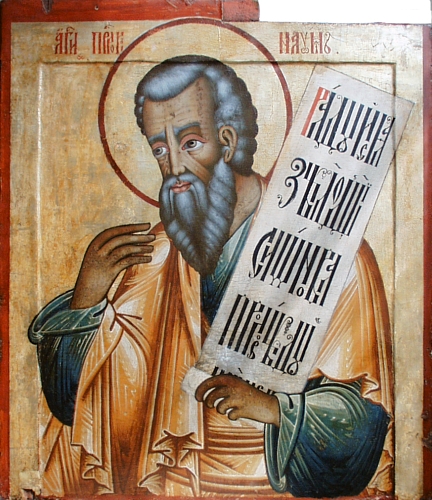
image source: http://commons.wikimedia.org/wiki/File:Nahum-prophet.jpg
Image is an 18th Century Russian Orthodox icon of Nahum.
Nahum 1:1 introduced us to the book.
The oracle against Nineveh; the book of the vision of Nahum the Elkoshite:
(NET)
The nation of Israel was formed out of the people that left Egypt, one of the big powers in the region. As Israel grew, they faced threats from various nations. One of them was the Assyrians based in Nineveh. Israel was unified under Saul, David and Solomon but they divided and eventually, the northern part was conquered by the Assyrians with the fall of Samaria in 722 BC. The Assyrians would be supplanted by the Babylonians when Nineveh fell in 612 BCE. Nahum made reference to what appeared to be a conquered Thebes in Nahum 3:8 which suggests that this book was written at some point after the fall of Thebes in 663 BCE and prior to the fall of Ninevah. To get a good overview of the historical timeline, be sure to check out Bill Creasy's web page.
I took a look at Walter Kaiser's commentary that covered Micah to Malachi (pp. 97-98) to find out what we know about Nahum. Kaiser reported that all we know is his name from this verse! The name in Hebrew means "comfort" or "consolation." Kaiser added that the location of Elkosh is uncertain but is suspected to be 25 miles southwest of Jerusalem.
Lord, thank you that you have sent prophets through the ages to warn, comfort, challenge and teach us. Amen.
I'll also paste the text in the post using the NET Bible from http://bible.org since their copyright rules are crafted for the internet age.
When I started Blog Through the Bible, I could have started from Genesis and blog toward Revelation.
However, I opted to "jump" around for the sake of variety.
And so, now, let's go back to the Hebrew Scriptures and visit a book that probably doesn't get preached on very often. Have you heard a sermon in Nahum?
image source: http://commons.wikimedia.org/wiki/File:Nahum-prophet.jpg
Image is an 18th Century Russian Orthodox icon of Nahum.
Nahum 1:1 introduced us to the book.
The oracle against Nineveh; the book of the vision of Nahum the Elkoshite:
(NET)
The nation of Israel was formed out of the people that left Egypt, one of the big powers in the region. As Israel grew, they faced threats from various nations. One of them was the Assyrians based in Nineveh. Israel was unified under Saul, David and Solomon but they divided and eventually, the northern part was conquered by the Assyrians with the fall of Samaria in 722 BC. The Assyrians would be supplanted by the Babylonians when Nineveh fell in 612 BCE. Nahum made reference to what appeared to be a conquered Thebes in Nahum 3:8 which suggests that this book was written at some point after the fall of Thebes in 663 BCE and prior to the fall of Ninevah. To get a good overview of the historical timeline, be sure to check out Bill Creasy's web page.
I took a look at Walter Kaiser's commentary that covered Micah to Malachi (pp. 97-98) to find out what we know about Nahum. Kaiser reported that all we know is his name from this verse! The name in Hebrew means "comfort" or "consolation." Kaiser added that the location of Elkosh is uncertain but is suspected to be 25 miles southwest of Jerusalem.
Lord, thank you that you have sent prophets through the ages to warn, comfort, challenge and teach us. Amen.
Sunday, September 12, 2010
Copyright Statement
I have to say I hadn't even thought about the issue of copyright until I read this item over at the web site that hosts the NET Bible. Excerpt: Bible copyright policies typically require special permission before Internet posting, writing commentaries, allowing mission organizations to translate works into other languages, or when quotations exceed some verse limit.
Unless I crawl through all the blog posts on this site and count up the verses I've cut and pasted, I have no way of knowing if am out of compliance in terms of exceeding the number of verses cited without obtaining written permission. Likewise, I haven't indicated the version I was citing at the time of preparing the blog post. In any event, it would be a lengthy effort to fulfill the letter of the law in this case.
I hope this effort here will be taken as a good faith effort to acknowledge the intellectual property rights of the various publishers Bible translations I have used on this blog.
I have tended to cite from the following translations:
English Standard Version
New American Standard Bible
New International Version
New King James Version
New Living Translation
The Message
Today's New International Version (No longer available)
New Revised Standard Version
New English Translation
Common English Bible
Unless I crawl through all the blog posts on this site and count up the verses I've cut and pasted, I have no way of knowing if am out of compliance in terms of exceeding the number of verses cited without obtaining written permission. Likewise, I haven't indicated the version I was citing at the time of preparing the blog post. In any event, it would be a lengthy effort to fulfill the letter of the law in this case.
I hope this effort here will be taken as a good faith effort to acknowledge the intellectual property rights of the various publishers Bible translations I have used on this blog.
I have tended to cite from the following translations:
English Standard Version
New American Standard Bible
New International Version
New King James Version
New Living Translation
The Message
Today's New International Version (No longer available)
New Revised Standard Version
New English Translation
Common English Bible
Sunday, September 05, 2010
Outline of II Peter
Introduction, 1:1-2.
The journey of faith, 1:3-4
1. Building on the faith, 1:5-8
2. A warning and an assurance, 1:9-11
The foundation of faith
1. The testimony of the apostles, 1:12-18
2. The testimony of the prophets, 1:19-21
The challenges to faith
1. False teachers harming the community, 2:1-3
2. Judgment falls upon those who have rebelled, 2:4-10
3. Characteristics of false teachers, 2:10-22
The conclusion of faith
1. The Day of the Lord, 3:1-10
2. How we ought to live, 3:11-18
The journey of faith, 1:3-4
1. Building on the faith, 1:5-8
2. A warning and an assurance, 1:9-11
The foundation of faith
1. The testimony of the apostles, 1:12-18
2. The testimony of the prophets, 1:19-21
The challenges to faith
1. False teachers harming the community, 2:1-3
2. Judgment falls upon those who have rebelled, 2:4-10
3. Characteristics of false teachers, 2:10-22
The conclusion of faith
1. The Day of the Lord, 3:1-10
2. How we ought to live, 3:11-18
Subscribe to:
Posts (Atom)