Friday, June 30, 2006

Philippians 1:12-18


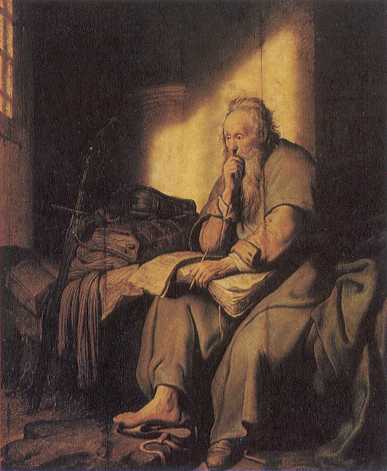
Rembrandt
"St. Paul in Prison"
1627

Image source: http://www.rembrandtpainting.net/complete_catalogue/storia_b/paul_prison.htm

Am looking at Philippians 1:12-18 this morning.

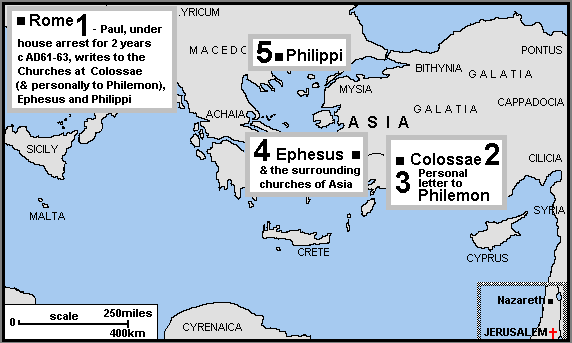
St. Paul was in prison when he wrote the letter to the church of Philippi.

But despite this he was able to see the bright side!

But I want you to know, brethren, that the things which happened to me have actually turned out for the furtherance of the gospel, so that it has become evident to the whole palace guard, and to all the rest, that my chains are in Christ; and most of the brethren in the Lord, having become confident by my chains, are much more bold to speak the word without fear.

Paul, the captive, had a captive audience in the form of the palace guards!

He also noticed that other people became more bold to speak about Jesus.

Unfortunately, some of the attitudes of the others who were speaking for Jesus was not ideal. Despite this, Paul wasn't going to lose his joy in the life of faith.

Some indeed preach Christ even from envy and strife, and some also from goodwill: The former preach Christ from selfish ambition, not sincerely, supposing to add affliction to my chains; but the latter out of love, knowing that I am appointed for the defense of the gospel. What then? Only that in every way, whether in pretense or in truth, Christ is preached; and in this I rejoice, yes, and will rejoice.

What eventually happened to Paul?

This web page indicates he was executed after around AD 62. Excerpt:
After being held prisoner for two years and after hearings before the council of priests, before the Roman procurator Felix and his successor Festus, before Herod Agrippa II, and again before Festus, he appealed to Rome on his citizen's right. So he was sent to Rome under guard. (Acts 21.27–28.31.) On the way they were shipwrecked on Malta but finally landed at Puteoli (Puzzuoli). Paul was imprisoned (A.D. 60) in Rome but was allowed to conduct his ministry among the Roman Christians and Jews who visited him. Of his final fate tradition says that he was beheaded south of the city, near the Ostian Way, probably during the persecution of Nero. A lesser tradition claims that Paul was released after his first imprisonment and that he went East again, and perhaps also to Spain, before his martyrdom. Some scholars believe that Paul was executed after his initial imprisonment, probably A.D. 62. St. Paul's tomb and shrine are at the Roman basilica of St. Paul's Without the Walls.
Another web page I found discusses briefly that Paul may have been released such that Paul traveled to modern day Spain and Great Britain. In the Wikipedia article, the author places Paul's death at AD 64 or 67. Excerpt:
We are forced to turn to tradition for the details of Paul's final years. One tradition holds (attested as early as in 1 Clement 5:7, and in the Muratorian fragment) that Paul visited Spain and Great Britain. While this was his intention (Rom 15:22–7), the evidence is inconclusive. Another tradition places his death in Rome. Eusebius of Caesarea states that Paul was beheaded in the reign of the Roman Emperor Nero. This event has been dated either to the year 64, when Rome was devastated by a fire, or a few years later, to 67. One Gaius, who wrote during the time of Pope Zephyrinus, mentions Paul's tomb as standing on the Via Ostensis. While there is little evidence to support any of these traditions, there is no evidence contradicting them, and no alternative traditions of Paul's eventual fate. It is commonly accepted that Paul died as a martyr in Rome. According to Bede in Ecclesiastical History from Vatican library sources, his mortal remains were given to Oswy, King of Great Britain, by Pope Vitalian in 665.
Lord, I pray for those who are Christians in countries where it is dangerous to be a Christians. Give them strength to persevere. Give them joy in knowing you are with them. Help them share the love of Jesus with those around them. Help us here in the USA to be bold for you. Amen.

Thursday, June 29, 2006

Philippians 1:3-11


image source: http://www.ccel.org/bible/phillips/CPn11Philippians.htm

Philippians 1:3-11

There are passages written by St. Paul that are deeply theological. The Book of Romans comes to mind.

There are passages where St. Paul has to play the tough guy and call people out. Parts of 1 and 2 Corinthians are examples of tough love.

Here we have a beautiful example of how St. Paul loved the people in his life deeply.

Affirming by Thanksgiving

I thank my God in all my remembrance of you, always in every prayer of mine for you all making my prayer with joy, because of your partnership in the gospel from the first day until now.

Paul's life was about telling people about the Good News of what Jesus did to restore us to God. The Philippians were supporters of his work.

Paul arrived in Philippi in Acts 16:12. They didn't get to stay long as the Roman authorities booted them out of town in Acts 16:35-40. Apparently, even though Paul was no longer with them, they somehow managed to keep in touch such that Paul was very thankful for them. We have a hint of this in Philippians 4:14-16 where is sounds like the Philippians provided financial support for Paul.

Pointing to a Hopeful Future

And I am sure of this, that he who began a good work in you will bring it to completion at the day of Jesus Christ.

There are few things more encouraging than to know that someone believes in your potential and possibilities for a blessed future. We are all a work in progress and He isn't done with us. Thus, our hope isn't based on us and our solo efforts.

Expressing Personal Feelings

It is right for me to feel this way about you all, because I hold you in my heart, for you are all partakers with me of grace, both in my imprisonment and in the defense and confirmation of the gospel. For God is my witness, how I yearn for you all with the affection of Christ Jesus.


When was the last time any of us have said to someone, "I hold you in my heart?"

Or, "I yearn for you?"

I suppose newlyweds might talk that way!

Nonetheless, there is power in sharing ones feelings isn't there?

Notice that Paul is in prison! Yet, he is finding ways to encourage others. I think that kind of attitude is only possible when there is a higher power at work in our lives. I know how it is easy for me to get into a woe is me pattern.

Desiring the Growth of the Other Person

And it is my prayer that your love may abound more and more, with knowledge and all discernment, so that you may approve what is excellent, and so be pure and blameless for the day of Christ, filled with the fruit of righteousness that comes through Jesus Christ, to the glory and praise of God.


When we love someone, we want the best for them. There is not a "thing" on this list. The list is about character and relationships: love, knowledge, discernment, purity and righteousness.

We don't know what Paul looked like.


image source: http://www.oldmasterpiece.com/painting-en_286.html by Rembrandt c. 1657

But we do know what Paul's heart looked like from this passage.

Lord, teach me to pray and care for others like the way Paul did. Help me to grow in love and knowledge and discernment so that I can live a life of righteousness. Amen.

Tuesday, May 30, 2006

Philippians 1:1-2

The Bible is 66 books. 39 in the Old Testament and 27 in the New Testament.

How long will it take to blog through the entire Bible?

I suspect this will be a life-time project!

The intent will be to provide a personal look at the Scriptures. It will be more devotional than technical. However, I will occasionally delve into more technical issues but only at a lay-level. This blogger is not theologically trained nor familiar with the original languages (New Testament Greek and Old Testament Hebrew).

I suppose I could start from Genesis 1:1 but I think I'll jump back and forth between the Hebrew and Christian Scriptures.

One of my favorite portions of the Bible is St. Paul's letter to the Philippians.

Philippians 1:1-2
Paul and Timothy, servants of Christ Jesus, to all the saints in Christ Jesus who are at Philippi, with the overseers and deacons: grace to you and peace from God our Father and the Lord Jesus Christ.


St. Paul is clearly one of the major figures of Christianity after Jesus. 13 of the New Testament books are believed to have been written by Paul.

Timothy is Paul's protege. Paul met Timothy in Acts 16 and from that point on, Paul trained him up.


Image source: http://www.bibleplaces.com/images/Philippi_acropolis_from_east_tb_n011201.jpg

Philippi is a city in Eastern Macedonia. Go here for some history.
Excerpt:
The Apostle Paul's travels to Philippi can be found in Acts chapter 16. Paul's visit to this city takes place shortly after the outset of his second missionary journey around A.D. 49. Some believe that Paul was in this city sometime in the summer to early fall of A.D. 50.
.........
Paul no doubt had much correspondence with the church at Philippi. The letter that we have today known as Paul's Epistle to the Philippians is likely written from Rome while Paul was under house arrest. Written circa A.D. 61, this letter corresponds to a church that has been in existence for over a decade from Paul's first visit there.
To see some additional photos and read some additional history check this page out.

"Overseers and deacons ... "

Sounds very Presbyterian! 8-)

For the non-presbyterians who have stumbled onto this page, one point of emphasis in presbyterian churches is that they are led by overseers (or elders) and deacons.

"grace to you and peace ... "

I heard a definition of grace that uses the letters in grace: God's Riches At Christ's Expense. There is probably no better hymn about grace than Amazing Grace:
Amazing grace! How sweet the sound
That saved a wretch like me
I once was lost but now am found
Was blind but now I see ...
As for peace, it is not just the absence of conflict but I think of peace as a sense of well-being.

We need grace and only God can give it. We need peace and again, only God can provide it. Lord, help me be an instrument by which Your Grace and Peace reach people. Amen!